
<?xml version="1.0" encoding="utf-8" ?>
<rss version="2.0"
    xmlns:dc="http://purl.org/dc/elements/1.1/"
    xmlns:sy="http://purl.org/rss/1.0/modules/syndication/"
    xmlns:admin="http://webns.net/mvcb/"
    xmlns:rdf="http://www.w3.org/1999/02/22-rdf-syntax-ns#"
    xmlns:content="http://purl.org/rss/1.0/modules/content/">

	<channel>
		<title>Chase Custom Homes : Blog</title>
		<link>http://denvercustomhomebuilder.com/http://denvercustomhomebuilder.com/</link>
		<description></description>
		<dc:language>en</dc:language>
		<dc:creator>doug@unleadedgroup.com</dc:creator>
		<dc:rights>Copyright 2011</dc:rights>
		<dc:date>2011-09-15T23:45:11+00:00</dc:date>
		
		<admin:generatorAgent rdf:resources="http://www.expressionengine.com" />
		
		
			<item>
				<title>Patio surface materials for custom homes range from beautiful to magnificent</title>
				<guid>http://denvercustomhomebuilder.com/blog/post/patio-surface-materials-for-custom-homes-range-from-beautiful-to-magnificen#When:23:45:11Z</guid>
				<description>
					<![CDATA[<p>Selecting just the right patio surface for a custom home’s décor is about realizing the dream. Choose from patio stones and custom stone work, to brick, cobblestone, tile, gravel, wood and composite decking. 
</p><p>Building a custom home is the realization of every detail of the dream, and since the homeowner will most likely spend a great deal of the warmer months outside on the custom patio and terrace, the selection of the surface material for such amenities is a key specification in making the dream a reality.</p>

<p>The patio surface, of course, should be beautiful and match the décor of the dream, but it should also be long lasting and easy to maintain throughout the year. </p>

<p>There are many choices for the patio/terrace surface, ranging from stone, brick and concrete, to wood and the new wood-alternative composite materials being used for decking materials on raised patios, decks and extended porches. And there are many choices within each category.</p>

<p>One of the more popular patio surface materials is stone, and this makes sense as stone work for house walls, sidewalks, fencing and even such indoor surfaces as entryways and kitchen floors is an ever-increasing option chosen by buyers in the custom home market. </p>

<p>The simplest application of stone for the patio surface is the use of patio stones, or paving stones. These are manufactured stones of pressed concrete that come in a variety of shapes and sizes, including flat squares and rectangles, generally in the size neighborhood of 2’ X 2’, 2’ X 2 1/2’, and 2’ X 3’. These are often selected because of the relative ease of installation and the overall low price.&nbsp; The good news is that patio stones are now available in a wide assortment of colors and textures (like exposed aggregate). Homeowners who choose this option often use bricks, landscape rocks or rot-resistant wood (e.g. cedar) for accents, borders and trimming material.</p>

<p>However, when it comes to stone for patios, the highly popular choice is natural stone, like flagstones and slate,&nbsp; and also setts, which are most notably known as cobbles, or cobblestone, once very popular as street paving material. Stone work is the most expensive option for patio surfaces, as the stones are heavy, come in varying widths and require expert cutting, installation and masonry work to be done  properly, and they often also require a great foundation, like concrete, to keep the surface from shifting. The upside is that stone is highly durable and will last a lifetime, is easy to maintain, and also works well for such patio amenities as outdoor kitchens, barbeque venues, decorative garden walls, and fire pits. Stone is also available in a variety of natural colors – black, greys, reds, browns, etc.&nbsp; It should be noted that while slate is very popular and makes a very attractive surface, it is also quite slippery when wet.</p>

<p>Another excellent choice for the patio surface is brick, as bricks – essentially manufactured clays and stones – come in a vast array of shapes, sizes and colors. Experienced bricklayers are experts at creating wonderfully beautiful patterns in the brick, as well mixing and matching brick sizes and colors to create designs that many people consider sheer artwork. Brick is highly durable and has become a very popular choice for walkways on college campuses, corporate office parks, municipal parks and other high-traffic areas where beauty and durability are often desired. </p>

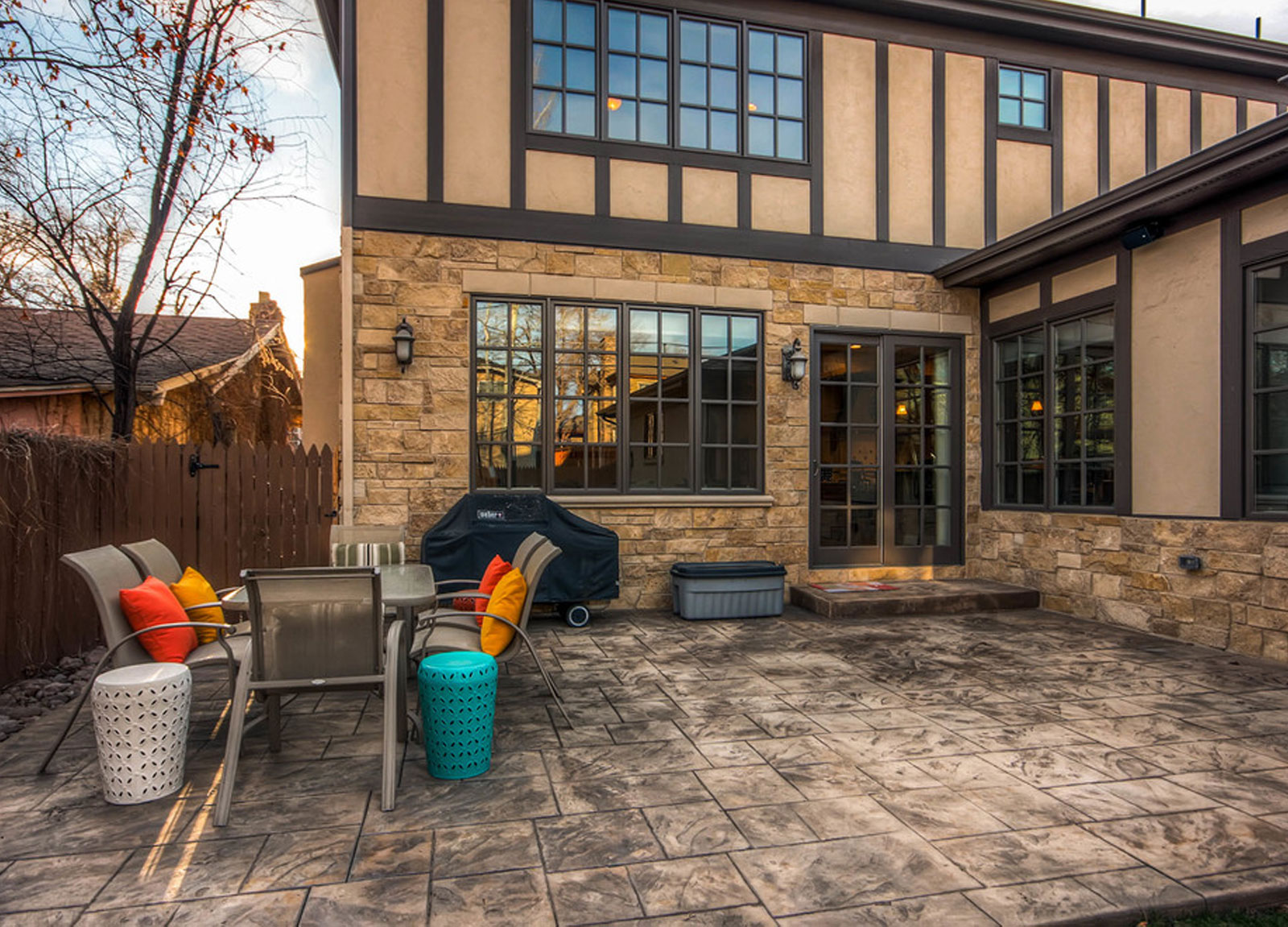
<p>Concrete patio surfaces are also popular because concrete, starting out as a mud-like, malleable liquid, is relatively inexpensive and easy to work with. The added advantage is that concrete surfaces can range from standard sidewalk-like concrete, to very fine new applications where nearly the entire color palate is available. In addition, with techniques like stamping concrete it is possible to create a plethora of surface-interest designs, and many people are opting for multi-media surface treatments where decorative concrete is sued along with stone, tile and brick work to make truly unique surfaces. Concrete surfaces can range from rough to highly textured, as well as very smooth fine treatments. </p>

<p>Tile is also being used for patio surfaces, and is a popular choice because many custom homebuilders are using terrazzo and other tiles for kitchen and entryway floors and homeowners want to keep design elements in their new homes consistent. Tile is also very durable, available in a wide variety of colors, and is often painted and kiln-fired with beautiful designs for the entire flooring surface or for accents and trim (think Italian tile). The cost for such material can range from the pedestrian to astronomical, but it will maintain its beauty for a very long time.</p>

<p>One of the more unusual choices for a patio surface – but one gaining in popularity – is gravel. Generally installed with edging board to keep the gravel in its place, this soft type of surface is among the most inexpensive to buy and install, comes in a good ranging of colors (many people mix and match for a “salt and pepper” look), and works well in conjunction with brick, stone, tiles, and wood in creating multi-media designs. Gravel patios, many believe, are very attractive, however the stones tend to gravitate to the lawn, inside the house, etc., they can be difficult to walk on for some people, and they are nearly impossible to shovel in winter when the snow flies. Gravel surfaces also need to be regularly raked to maintain a tidy appearance. </p>

<p>Sometimes – often, in fact – the choice for a patio surface is not a patio in the classic sense at all, but rather a deck. Usually decks are constructed above ground overlooking the lawn, but many people opt for surface decks for a decorative appeal. The most obvious choice for a deck, of course, is wood, and many people opt for such rot-resistant and durable wood as cedar, as well as other varieties treated for longer-lasting durability. Wood is very beautiful, of course, but among the many types of patio/deck surfaces it also requires the most maintenance, as it is subject to the wear and tear of sunshine, rain and cold temperatures. </p>

<p>A popular alternative choice over the last decade or so is so-called wood-alternative materials, often referred to as composites. These actually come in two varieties: composite, which is a mixture of plastic and wood fiber materials, and boards made of PVC materials. The advantages of composites are many. Since they are manufactured they can be created in just about any color desired, and in the manufacturing process a vast array of surfaces or patterns can be added in. Many people opt for composite boards that have the look of wood grain, for instance. Also, composites often can be painted, just like wood, so color choices can range from the mundane to the highly creative. A slight disadvantage to composite material is tensile strength: the boards tend to be more flexible than wood of the same dimensions, so the construction often requires more joists or underlying structure to prevent bending (which can force nails and screws to rise). Composites are, however, much more durable than wood, as these materials are less affected by weather wear and tear, and they require less frequent maintenance. </p>

<p>Like everything else in the custom home, researching and selecting just the right surface for the dream patio can be time-consuming. But the pay-off – an outdoor living space worthy of frequent use and entertaining – is great indeed.</p>

]]>
				</description>
				<dc:subject></dc:subject>
				<dc:date>2011-09-15T23:45:11+00:00</dc:date>
			</item>
		
			<item>
				<title>Simple Tips for Keeping a House Cool in Summer</title>
				<guid>http://denvercustomhomebuilder.com/blog/post/simple-tips-for-keeping-a-house-cool-in-summer#When:23:42:53Z</guid>
				<description>
					<![CDATA[<p>Whether it’s a new custom home or an existing lifestyle, there are several techniques any homeowner can employ to keep cooler in the summer and lower energy bills. They most work well for winter needs as well.
</p><p>Here in Denver, August 2011 proved to be a hot one – it has just been certified by the National Weather Service as the hottest August on record, narrowly edging out August 1937 for the highest average temperature for the month, 77 degrees this August versus 76.8 back in the Franklin Roosevelt administration. </p>

<p>Yes, September is here and Autumn and cooler weather is on the way, but the Summer of 2011 has a lot of people wondering how best to keep a house cool when the thermometer continually rises above the comfort zone. It’s not only just a comfort issue, of course: people with air conditioning or swamp cooler units know all too well that energy bills for this summer season also hit record highs, and they are looking for a little cost relief as well. </p>

<p>At Chase Custom Homes we build custom homes for clients throughout the year, but anytime a project is started one of the key questions that arises in the design phase is how to build a dream home that will stay cool each and every summer, keeping that dream comfortable for the people inside and their pocketbooks.</p>

<p>The good news is that Denver isn’t Oklahoma City or Atlanta or Cincinnati or any number of American locales where the locals are fond of saying “if it isn’t the heat, it’s the humidity.” Colorado, of course, enjoys relatively low humidity, so while 98 degrees is indeed hot in these parts, it doesn’t compare with the sweltering degrees-plus-high-humidity you’ll find in many other places. Still, keeping house temperatures low in summer is a high priority. And, many of the techniques to keep the house cool also work well, with some alterations, at keeping it warm in winter and keeping heating costs low. </p>

<p>There was a time, of course, before there was air conditioning or even electrics fans, and architects, builders and city planners of the day put a lot of effort into making a house palatable for weather extremes. For city planning, consider this: Denver is laid out on a north/south grid so that most of the housing faces east or west, limiting the southern, hotter exposure and the northern, colder exposure. Then all those beautiful deciduous trees that line the parkways and rights-of-way between the street and sidewalk where added for much more than the aesthetics, but also for the shade that offers relief from the summer sun (and with the leaves gone in winter, sunlight warmth comes through). </p>

<p>Builders of the day made sure that homes were constructed with ample windows that provided cross ventilation, and with porches that further provided shade, particularly for the front and back windows and entrances. The ceilings were high to allow heat to rise, as well. Ask anyone who lives in a home that’s a century old or more and they will invariably note how cool the house stays, particularly in the downstairs, even on the hottest days. This was no accident. </p>

<p>Like everything else we humans did over the last century when technology and modern conveniences were looked at to overcome any challenge, we somehow lost the art of homebuilding blending in with the environment, and relied instead on air conditioning and modern heating sources to do the job. Only with rising energy costs and a heightened concern for our impact on the environment have we begun to think of the simple measures our great grandparents knew as common sense.&nbsp; </p>

<p>There are, of course, lessons in this, and we at Chase Custom Homes, as homebuilders, put a lot of thought into the art of homebuilding. We think of site acclimation, shade sources, workable windows, window size in conjunction with exposure, lighter-colored roofs and paved surfaces that reflect more heat, and building materials for the foundations and walls that eschew heat build-up and also support inside temperatures – warm and cool – with less outside influence when necessary. We also take a close look at window coverings that are versatile for both reflecting heat and retaining warmth depending on the season, porches and patio coverings that enhance comfort, ceiling fans that add beauty and boost both cooling and heating, and we go the extra mile in the design of HVAC systems that promote both cooling and heating at the highest efficiencies possible. </p>

<p>Of course, if it’s a new home under consideration we can design in both the age-old techniques in the art of homebuilding, as well as the modern conveniences of life, and get just the right combination for modern living. But any homeowner can look at a few Simple Tips for Keeping a House Cool in Summer, not to mention more efficiently warm in the winter, to add to their comfort and financial well-being. </p>

<p>•	Shade. It can’t be stressed too much. Plant trees and bushes, add awnings or porch roofs: anything that can block as much direct sunlight from hitting the windows, doors and roofs of a house will go a long way in keeping the house cool and reducing cooling costs. <br />
•	Great windows. Old windows that don’t insulate as well or don’t open anymore aren’t helping the cooling or heating situation. Replacing windows will, particularly those in strategic locations for cross-ventilation or in high-use rooms. And get windows that OPEN – open windows can add comfort in Spring, Summer and Fall.&nbsp;  <br />
•	Window coverings. You know where the sun hits your home throughout the day, especially in the late afternoon when the heat index is at its highest, so get curtains or blinds that block as much of the sun’s rays as possible. <br />
•	Close the house tight during the day. In Colorado, the evening and night gets relatively cool even on the hottest days, and the house will also cool off. By keeping the house sealed up tight during day, the amount of heat and humidity that enters the structure will be minimized. While you’re at it, check all the seals around windows and doors to block indoor/outdoor air exchange (also good for winter).<br />
•	Ventilate, particularly at night. Open windows at night, particularly to create cross-ventilation, and this can be enhanced with the use of electric fans placed in the windows to draw the cooler air in (just be sure to close the windows and turn off the fan during the day when the opposite will occur). Also, keep interior doors open to facilitate air flow.<br />
•	Ceiling fans. Ceiling fans really help to keep indoor air temperatures down in the summer (and up in winter) by circulating the air.<br />
•	Limit the use of hot appliances. Try as much as possible not to use the oven, stove, dishwasher, or laundry, or at best limit their use as they each add a ton of unwanted heat in living spaces. Run the dishwasher or laundry overnight.<br />
•	Lights add heat. As anyone with a Depression-era father already knows, turning off lights saves money – and it also reduces heat. Use as few lights as possible in the home to reduce heat, and where possible use fluorescent lights or the new spiraled CFC light bulbs, both of which give off less heat and use less energy.&nbsp;  </p>

<p>Air conditioning and swamp coolers add to the comfort of any home, but there are several issues related to them that homeowners should be aware of to enhance comfort and save money.</p>

<p>•	Get a new unit. If you’re swamp cooler or air conditioning unit are more than 7 years old, consider getting a new one. The newer ones, and especially those rated EnergyStar, are much more efficient, putting out more cool air and costing less that units new just a few years ago. <br />
•	Clean filters. Clogged filters rob these units of efficiencies, and cleaning out the filters every two weeks or so will keep them working as they were designed.<br />
•	Shade the units. Whether it’s an A/C unit outside off the side of the house or a swamp cooler up on the roof, the more the sun beats down on it the harder it will have to work. Cover them, plant trees to block the sun, build a structured roof (several feet above the unit) to block direct sun, move the units to a more shady spot (like on the north side of the house.<br />
•	Close of rooms. Back to that Depression-era father: “I’m not cooling off the neighborhood!” Shut the vents or the doors in unoccupied rooms and cool only the spaces that you will be spending time in.<br />
•	Use ceiling fans. Once again, air circulation will enhance the efficiency of any cooling unit.<br />
•	Get a programmable thermostat. This also work well for winter, but a relatively inexpensive programmable thermostat helps manage indoor temperatures much more. It will minimize the use of appliances when people are working or at school, and can be programmed to cool down or heat up just in time for the arrival home. Many of the newer ones can even be operated remotely on a computer or smart phone, so alte5rations – like an unexpected dinner out – can be taken into consideration easily. </p>

<p>As has been noted, most of these techniques will also help with improving comfort and boosting energy efficiencies throughout the year, so while you may be contemplating the winter don’t forget that another summer will be just around the corner. </p>

]]>
				</description>
				<dc:subject>Trends</dc:subject>
				<dc:date>2011-08-17T23:42:53+00:00</dc:date>
			</item>
		
			<item>
				<title>Recycled/reclaimed materials offer custom homebuyers beautiful design options and environmental cred</title>
				<guid>http://denvercustomhomebuilder.com/blog/post/recycled-reclaimed-materials-offer-custom-homebuyers-beautiful-design#When:00:15:42Z</guid>
				<description>
					<![CDATA[<p>From old barn wood and beams, to antique fixtures and recycled roofing and insulation, the recycled/reclaimed marketplace is a hot commodity
</p><p>When choosing to build a new custom home, many people, for a variety of reasons, are exploring the use of recycled materials in the building process. There are environmental concerns, of course, particularly for those looking for LEED certification on their new home, and there are also such advantages as cost containment and aesthetic value of historic wood, stone and fixtures.</p>

<p>In any case, there are a number of plusses in utilizing recycled materials in a new custom home, but also a few drawbacks to consider.</p>

<p>One of the most popular uses for recycled materials in any new custom home project is the installation of wood that has been previously used in an older home or building. Often referred to a reclaimed wood, this category includes such things as barn wood taken from historic farm structures for use as flooring, wall coverings, ceilings and cabinetry; historic cabinets and built-ins that have been recovered from demolition projects and refurbished to retain their timely charm but meet modern demands; and, old solid beams of wood that were a staple of construction in the 19th and early 20th centuries for use today as both decorative and functional beams for a rustic look.</p>

<p>The advantage of old, reclaimed wood – in any form – is that much of it was originally milled at a time when plenty of old-growth virgin forests where trees with impressive girths were harvested. The wood produced from such harvesting was much higher quality than can be found on the market today, and often things like beams were hewn from a single trunk, rendering them extremely strong and stable. Also, wood that has cured for a century or more is preferable to using green wood, artificially cured. The beauty, of course, is undeniable, and often the grains re-milled for today’s uses offer an impressive display of the lumberman’s art, as well as a highly durable material.</p>

<p>The pitfalls could include that reclaimed wood from barns and older structures might have been damaged over the years by water, mildew exposure to fire, and/or insect infestation, which could lead to a breakdown in the material’s durability and to an odor that is difficult to mask. When sourcing such reclaimed wood it is wise to work with reputable wood reclamation companies that can certify the moisture content or damage in the wood, as well as any residual smoke penetration.</p>

<p>Another chief area popular for recycled/reclamation use is glass, as in leaded glass and historic stained glass creations, and people use old windows and old window glass for decoration, entries, cabinet faces and display cases. Ever been in an old house and seen those windows that appear not to be smooth, but rather slightly rippled? Glass manufacturing has come a long way in the last 100 to 150 years, but a lot of people like the charm of the old-looking glass.</p>

<p>The disadvantages of using old glass are that, while quaint and attractive, its durability is suspect; old glass tends to be more brittle than modern glass. Also, they didn’t make windows back then with the amount of insulation value that we have today, so old glass used on outside windows, for instance, probably need to be embedded in new glass to boost R-values and to protect from breakage.</p>

<p>Stone, slate and reclaimed tiles are also very popular in many custom home designs. Used as roofing material, sidewalks and pathways, flooring, kitchen counters and backsplashes, and for decoration and function in bathroom sinks, tubs showers, and floors, these materials are often very beautiful, in some cases created by long-past craftsmen, and they offer a high degree of durability along with the aesthetic values. And often, reclaimed stone – marble comes to mind – has the charm of a weathered or even worn look that immediately speaks to its historic value. Sometimes referred to an “old-quarry” stone, some of this material is reclaimed from elegant homes and official buildings and may also come with a story to tell – e.g., “our kitchen floor used to be the lobby of the old Supreme Court building.”</p>

<p>And don’t forget old, reclaimed fixtures and lights: old stoves, chandeliers, bathtubs, sinks, even toilets or “water closets” (we’ve even seen rail cars and historic phone booths incorporated into home design) are hot items in the r3ecycled/reclaimed marketplace. Antiques of any stripe are also highly sought after.</p>

<p>Of course, for those looking to garner LEED certification in the homebuilding project, there are any number of recycled and reclaimed materials to draw from, including lumber scraps from other projects, remanufactured tires and paper used for insulation,&#8212;really just about any building material you can think of. There are a myriad of firms which specialize is collecting and repurposing leftover materials for the burgeoning recycled/reclaimed marketplace. The web is replete with such resources. The advantage is that these materials often cost far less than new and can qualify for LEED certification, particularly if they are sourced locally. The disadvantage is that since they are reclaimed materials the quantity needed may be in short supply, and finding that same material again if it needs to be matched may be difficult. Keep in mind that reclaimed materials often skip the recycling process, so the environmental impact is lower.</p>

<p>Reclamation and recycled materials are hot commodities these days, so the competition to find them can be fierce, and the prices often reflect the growing demand. However, many people are looking to make an environmental statement in their new home as well as tap into history, so there is also a growing supply chain.</p>

<p>For all of your custom home building needs, including expertise in recycled/ reclaimed building materials, amenities and accessories, look to Chase Custom Homes of Denver. Call 303-p204-9254 for<br />
complete details on the whole range of custom home building services we offer. A Chase Custom Home is an address for a lifetime.</p>

<p>Most products headed to the landfills at this very moment could have been recycled, or better yet, reclaimed for use in a new building or other practical or artistic function. Recycled products are multitudinous in number and diverse in sources as well. For instance, recycled newspaper can be reused for home insulation, plastic bottles transformed into playgrounds, tires into sidewalks and so on.</p>

<p>Reclaimed materials skip the recycling process, thus using less energy between removal and reuse. Common reclaimed materials include: wood products from old barns and homes, bricks and other used masonry units, doors, paneling and a slew of other building products. While there is no specific certification for reclaimed materials, their use counts significantly toward LEED and Living Building certification.</p>

<p>Products claiming to be part or all recycled content can be certified by Scientific Certification Systems (SCS) and will bear the SCS Certified logo. SCS offers certification to manufacturers of products made from recycled or biodegradable materials. An excellent online resource for recycled and reclaimed materials is PlanetReuse, a global guide for finding locally available reclaimed and reusable materials. In the following articles, you&#8217;ll find a list of recycled products and materials commonly available in most areas, as well as information to help locate and purchase them.</p>

<p>So what exactly is a reclaimed wood floor?</p>

<p>You might find it under many names, such as recycled wood flooring, reclaimed wood flooring, or even reclaimed salvage lumber.</p>

<p>Whatever the name, the product is re-used, recycled or, as often titled, &#8220;reclaimed&#8221; flooring made from wood that is generally re-milled to be usable in a new application. </p>

<p>Pros and Cons</p>

<p>If you&#8217;re considering reclaimed wood for your floor, you&#8217;ll want to know what to look for. It is obviously a &#8220;green choice&#8221; to choose to re-use wood that would otherwise become landfill waste. Recycled wood floors also save precious forest growth.</p>

<p>Here are some more reclaimed wood benefits:</p>

<p>* Environmentally-friendly</p>

<p>* Warm look and feel</p>

<p>* Prevents waste</p>

<p>* Easy to clean</p>

<p>* Naturally insulating</p>

<p>* Depending on thickness, may be refinished years later</p>

<p>* May increase the value of your home</p>

<p>You may be able to harvest some reclaimed wood on your own - at a discount. If you know of a building about to be torn down, it wouldn&#8217;t hurt to ask if you can buy (or remove) some wood from the premises.</p>

<p>You might be surprised to learn that there are local companies that supply reclaimed wood. If so, you could save shipping costs and conserve fuel that would be spent if the product was shipped a long distance. This would be an ideal green alternative to new wood harvesting for your project.</p>

<p>Some suppliers also carry the FSC label (Forest Stewardship Council). According to their website, they promote responsible management of the world&#8217;s forests, and require certain standards to be met. They also provide FSC certification. You can even find FSC certified wood at some local home improvement stores such as Lowe&#8217;s or Home Depot.</p>

<p>A few suppliers of reclaimed wood include:</p>

<p><a href="http://www.terramai.com/">Terra Mai</a></p>

<p><a href="http://www.ecotimber.com/">Eco Timber</a></p>

<p><a href="http://pioneermillworks.com/">Pioneer Millworks</a></p>

<p><a href="http://www.mountainlumber.com/">Mountain Lumber Company</a>
</p>]]>
				</description>
				<dc:subject>Home Buying Resources,Green Home Building,Trends</dc:subject>
				<dc:date>2011-07-27T00:15:42+00:00</dc:date>
			</item>
		
			<item>
				<title>In a new custom home a professional interior designer invariably raises the “wow factor”</title>
				<guid>http://denvercustomhomebuilder.com/blog/post/in-a-new-custom-home-a-professional-interior-designer-invariably-raises-the#When:02:54:13Z</guid>
				<description>
					<![CDATA[<p>Many people believe that interior designers raise the cost and take over the design control, but the truth is that they save money and far exceed homeowner expectations.
</p><p>DENVER, CO – Deciding to build a custom home is one of the most important and life-fulfilling decisions a person or couple will ever make. Custom means that it is not an off-the-shelf design, there is no inheritance of someone else’s tastes, and that it is a true expression of the new homeowners. An address for a lifetime.</p>

<p>We at Chase Custom Homes of Denver specialize in helping people realize their life-long dream of building just the home, their right home. We work with architects, financing experts, crafts people, and highly trained subcontractors to ensure that every system, every detail comes out just the way the homeowners envisioned it.</p>

<p>There are a ton of details that go into creating a custom home, everything from flooring, roofing and wall treatments, to landscaping, location, lighting and everything else. But a critical area of expertise that often comes into play when planning such a project is whether or not to hire a professional interior designer to shepherd the look of the living spaces. We couldn’t recommend interior designers more. We work with them on almost every project, trust their judgment, and, like the homeowners themselves, gape in awe at the result.</p>

<p>However, many people balk at the notion of hiring a professional interior designer, even on a custom home building project, and generally for two reasons: 1) the perception that an interior decorator will add a layer of expense that will push the budget; and, 2), the perception that the homeowner will lose control of the design process and end up with something other than they wanted.</p>

<p>Our experience is exactly the opposite. Professional interior designers have so many contacts with crafts people, painters, furniture makers and designers, flooring specialists, on and on, and access to “to the trade only” showrooms and catalogs. They most often can deliver the goods and their services for far less than the untrained neophyte could ever hope to tap. And, while many people fancy themselves good at interior design, our experience is that professional interior designers work closely with clients, and rather than overwhelming the homeowners, they almost always deliver a finished product that<br />
takes the dream to a higher – and highly desirable – level. In the many custom homes we have built, those of our clients who work with a professional interior designer are the most delighted with the results – financially and aesthetically.</p>

<p>Interior design isn’t a hobby that someone decides to make into a career. It is now a respected professional degree program at many top colleges and universities throughout the country, offering national accreditation through such organizations as the Council for Interior Design Accreditation (CDIC). In Colorado, Colorado State University in Fort Collins offers both a bachelor’s and master’s degree program in interior design with the College of Applied Human Services and the Department of Design &amp; Merchandising. There are also several interior design trade associations and certification programs where professional in the field keep up-to-date with the latest techniques and trends, as well safety issues and environmental applications.</p>

<p>Here’s what a professional interior will deliver to clients:<br />
• A vast network of crafts people – painters, carpenters, furniture makers, tile and stone specialists – who can deliver on nearly every promise imaginable.<br />
• Trade-only resources. Furniture, carpeting and flooring options, wall coverings, artwork, fabrics and textiles, linens, cabinetry, countertops, hardware, lighting, doors, appliances, and much more – all from showrooms and catalogs not open to the general public, and often at substantial savings. Also time savings, as they know the sources and ease the research process.<br />
• Space planning. Professional interior designers are highly trained in space planning techniques that get the most out of every size and shape of room.<br />
• Experience working with architects, contractors and subcontractors. Professional interior designers are particularly skilled at working with every aspect of the design-build process, helping to create the interiors as they are being designed.<br />
• Homeowners’ style. The object of professional interior design is not to make a design statement for the designer, but rather to fulfill the desire of the homeowner with real-world solutions.<br />
• Environmental expertise. Highly trained in environmental issues, including LEED certification processes, so that the installation and the operation of all living spaces will comply with environmental regulations for chemical use, waste mediation and energy efficiencies.<br />
• Electronic capabilities. Modern professional interior designers use specialized computer programs in the planning and design process, to create “virtual” spaces for envisioning a room before it is constructed.<br />
• Project guidance. Professional interior designers are on-site throughout the construction and finish to ensure that everything is done properly, and to make the adjustments necessary when unforeseen snags enter the picture.<br />
• Form and function. The study of interior design is not only about the look of living spaces, but also about how people use the space. This ensures that the homeowner has spaces that are aesthetically pleasing and work well for the lifestyle of the people occupying the house.</p>

<p>There’s a lot more, of course, as the checklist of items that go into the creation of exemplary interior spaces is long and varied. The bottom line is that in the experience of Chase Custom Homes, teaming up with a professional interior designer invariably results is raising the “wow factor” for clients building their dream home.
</p>]]>
				</description>
				<dc:subject>Home Buying Resources,Trends</dc:subject>
				<dc:date>2011-07-08T02:54:13+00:00</dc:date>
			</item>
		
			<item>
				<title>Hardwood Flooring Now the Standard of Excellence in the Finest American Homes</title>
				<guid>http://denvercustomhomebuilder.com/blog/post/hardwood-flooring-now-the-standard-of-excellence-in-the-finest-american-hom#When:18:48:18Z</guid>
				<description>
					<![CDATA[<p>With more than 560 species of wood to choose from, and even the unique artisan design of parquet, hardwood flooring fits with any décor and budget and offers easy care and long life. 
</p><p>DENVER, CO – Time was when a hardwood floor in a home was a sign of a lower socio-economic level, believe it or not. People coming of age in the post-WWII era thought wall-to-wall carpeting was an expression of higher status, and in many of the earlier suburban homes built in the late 1940s and into the 1950s featured plywood treatments for floors that were meant to be covered by carpeting or linoleum. </p>

<p>But when the next generation came of age in the late 1960s they lifted the carpets in older homes to discover the beauty of hardwood oak flooring that had been the standard of home design in the early part of the last century. They sanded them, polished them, bought area or oriental rugs to accent rooms and created a new standard of excellence in housing. </p>

<p>Indeed, hardwood flooring has become de rigueur in the finest homes, so much so that a study commissioned by the National Wood Flooring Association shows real estate agents, by a four-to-one margin, say a house with hardwood floors sells faster and brings a higher price than homes without the hardwood. </p>

<p>Evidence like that is hard to argue with. </p>

<p>Hardwood floors are very beautiful, extremely durable and come in such a wide variety of species and colors that they can meet the needs of any décor. There are up to 50 species of trees from around the world used for flooring in homes, with red and white oak, cherry, hickory, pine, ash, and maple leading the domestic choices, and such exotics as bubinga, teak, cork, curmaru, iroko, jarrah, mahogany, bamboo,&nbsp; and many more from around the world finding a place in American homes.</p>

<p>Plus, with expert artisans creating beautiful blends of wood in often intricate parquet designs, hardwood floors in homes can feature museum-quality designs unique to each property. </p>

<p>When considering food flooring for a home, there are essentially three types available from manufacturers and wood flooring contractors: 1)solid wood, which is exactly what it sounds like; 2) engineered wood, which is a layer of wood as a veneer over a sub-base made of other materials; and, 3) laminate floors, which use a photographic process to look like wood but aren’t actually wood at all, but rather a combination of resins and fiber board materials. </p>

<p>At Chase Custom Homes our experience is that the overwhelming choice is solid wood. Many of our customers select solid wood flooring options throughout the home, often with different types of wood and varying colors from room to room. Sometimes, but not always, these customers will select a type of stone or tile floor treatments for kitchens and bathrooms, but we are discovering more and more all the time that hardwood floors in the kitchen are the most popular choice. </p>

<p>Hardwood floors, as stated earlier, are quite durable and last a long time, and they offer the simplest maintenance: regular sweeping with a broom or dust mop, and the occasional vacuuming with a brushless vacuum is all that is required. </p>

<p>However, hardwood floors do require some attention. One of the first things is to work with your builder or installer on the proper finishes for the floors to ensure they will retain their luster and protect from moisture over the long haul. Homes with a lot of hardwood floors, particularly in a dry climate like Colorado, will benefit from the installation of a humidifier in the HVAC system to protect from premature drying of the wood. We have also found that wood is not the best flooring option in below-ground-level rooms like basements where moisture collection or flooding might be an issue. And homeowners should be advised that wet mopping wood floors or allowing spills to stay on the floor for extended periods of time is not a good idea. </p>

<p>Hardwood floors, while beautiful and durable, can also be easily dented. Experts advise people to keep rugs by outside doors for shoe-cleaning to prevent grit and grime to get ground in, and to avoid walking on hardwood floors in sports shoes or spikes. Oddly enough – and important to note – one of the main culprits in damaging wood floors are spike high heels, so ladies should be particularly diligent.</p>

<p>As mentioned above, parquet flooring is a popular choice because of the ability to create unique designs. Perhaps the most famous parquet wood floor in the world is (or was) at the Boston Garden where the Celtics have held court for decades, but have you seen the Ram’s horn designed built into the parquet in the Colorado State University basketball arena? It proves that with wood flooring anything is possible, from the whimsical to the elegant. </p>

<p>There are two other basic types of wood flooring to be aware of: Strip flooring, which is considered the “traditional” type of hardwood flooring, features strips a wood from 1-1/2” to 3” in width laid out in a linear pattern that adds depth to a room; and, plank flooring, which is generally from 3” to 7” in width, which has a more casual, even sometimes rustic look. Elegant rooms and décor usually call for either parquet or strip hardwood flooring, while activity rooms or period designs like Early American or Farm, House might be enhanced by plank flooring. </p>

<p>Here at Chase Custom Homes we find hardwood flooring so popular and so versatile that some form or another meets the needs of nearly every décor design and every budget. Even basic ash, pine or maple floors, which are very economical, offer a timeless beauty and range of color choice, and of course with exotics and unique parquet designs anything is possible. </p>

<p>When it comes to building a true dream home – and discovering the wonders of hardwood flooring – call on Chase Custom Homes at 303-204-9254. A Chase Custom Home is an address for a lifetime. </p>

]]>
				</description>
				<dc:subject></dc:subject>
				<dc:date>2011-06-21T18:48:18+00:00</dc:date>
			</item>
		
			<item>
				<title>Home Lighting Design is Often the Most Critical Element in Designing a Dream</title>
				<guid>http://denvercustomhomebuilder.com/blog/post/home-lighting-design-is-often-the-most-critical-element-in-designing-a-drea#When:19:42:38Z</guid>
				<description>
					<![CDATA[<p>Lighting creates a mood, provides security and enhances every home, and with advances in technology and aesthetic design the possibilities are endless and economical.
</p><p>DENVER, CO – If you walk into the new or remodeled supermarkets cropping up all over town you’ll see a palpable difference in the look and feel of the place, the ambiance – and it’s all designed to make you feel better and enhance your shopping experience. Yes, there are still aisles displaying food stuffs and hard goods, but the mood of the places has been softened and warmed. There’s less of a warehouse look, and especially in the produce department the displays are more inviting and the colors are more earthy. </p>

<p>But the major difference? It’s the lighting. Gone are the over-bright, ceiling-mounted fluorescent lights, and in are pendant lights, task lighting and accent lights, all with a warm glow. </p>

<p>This is no accident, and the trend toward better lighting treatments in all sorts of environments, from supermarkets and throughout retail, to office space, restaurants and entertainment venues, has been elevated from a necessity to an art. </p>

<p>Nowhere is this more important than in the home, however. Here at Chase Custom Homes we have discovered in the design and preparation of the custom homes we build that lighting is a key concern, taking up far more time than other home design features costing much more money. Homeowners looking to build their dream home have very particular perspectives on the lighting they desire in their new homes, and they often send us to other homes, hotels and, yes, even supermarkets, to see a lighting treatment that struck their fancy. Indeed, lighting plays such an important role in modern homes that when we discuss a home-building project with prospective architects, we specifically check their credentials, experience and portfolio as it relates to lighting to ensure they understand what is required and can deliver on the dream.</p>

<p>Lighting, of course, is a basic necessity in any home to see in the dark and provide for security, but it doesn’t have to be bare-bones overheads, lamps and porch lights – not anymore. There are four main kinds of lighting to consider, and each has its applications in every room of the house. Lighting designers – and yes, home lighting these days is so sophisticated that there are specific designers for that – talk of lighting in “layers,” with each different kind working together to create an overall effect. The four main groups of lighting are:</p>

<p>• Ambient. Ambient lighting is the basic lighting of a room or space, the general illumination that any rooms requires.</p>

<p>• Task. Task lighting highlights a particular area for the task at hand, such as pendant lights over a kitchen counter, work desk or sink.</p>

<p>• Accent. Accent lighting is used to highlight or accent features of the home, like architectural assets such as fireplaces, art work, or outdoors even a garden arbor or fountain.</p>

<p>• Decorative. Decorative lighting serves many functions, as it accents, and provides task and ambient lighting, but it is intended to be a focal point in and of itself. Think wall-mounted sconces in a hallway, or chandeliers in a dining area. </p>

<p>What is important is the right mix of light and types of light layers, to give each room in the home the ambiance desired as well as the functionality required. For instance, a kitchen may feature an overhead light to provide broad functionality when preparing a large meal, and the overhead light fixture can also be quiet decorative. A kitchen, however, may also feature recessed can lights in the ceiling to provide broad-spectrum ambient lighting or focused for counter-top task lighting, and many people these days are using highly decorative pendant lights for additional task lighting. Pendant lights come in many beautiful designs, and can have regular light bulbs or very specific LCD spot lights in varying sizes that are decorative in their own right. </p>

<p>And don’t forget the old stand-by: track lighting. Track lighting is a very popular choice, and in today7’s market the types of fixtures available are highly decorative. These types of fixtures can be used for overall ambient lighting and task lighting to multiple locations, and they often offer the added benefit of being flexible, meaning they can be moved on the track or on a swivel to serve several lighting needs. </p>

<p>We also see a lot of attention to little details in home lighting from our clients, such as the aforementioned sconces in hallways and stairways, but also accent lighting built into the molding on the tops of walls that warms a room and provides safety in passageways. We even have clients who incorporate aquariums into their lighting design, to provide for a special and interesting lighting solution and window between rooms for instance. </p>

<p>Of course, all of this and more also applies to outdoor lighting solutions, which not provide ambient, decorative, accent and task lighting for patios, gardens and lawns, but also provide a level of security for properties that is quickly becoming the standard for new homes. </p>

<p>Two other key considerations in any home lighting design are lighting controls and the “green” issue.</p>

<p>Beyond the lighting and the fixtures themselves, you want to make sure the controls for the lighting – the switches – are conveniently located and easy to operate. Dimmers give many of the fixtures the ability to go from loud and cheery to dark and romantic with ease. A plus is that today’s lighting designers have taken into account to look, feel and location of the switches so they can be hidden and easily accessed, or out in the open and highly decorative themselves.</p>

<p>The “green” issue is the electrical use this lighting design will demand, particularly in outdoor lighting which is designed to be on all night long. The incorporation of CFL (compact fluorescent lighting) and LCD lights, both of which use far less energy and generate less heat than traditional bulbs can mean that a vibrant, full home lighting system will use a fraction of the energy that the old lamps and overheads used. And modern technology in these types of light sources is delivering a broad spectrum of light choices, so you can create any mood desired without sacrificing energy savings. </p>

<p>Lighting is key to elevating the home into the cozy retreat many people envision. Done right and any mood can be created, any task undertaken and every security need met – all beautifully. </p>

<p>At Chase Custom Homes we are amazed on every new project how beautiful the lighting designs can be, and how far technological and aesthetic advances have come – and continue to go – as it r4elates to home lighting applications. In fact, the lighting in our projects is so integral to the home that many customers say the beauty of their new custom home comes to life – to “light” – even more in the evening and at night when the lights are on. </p>

<p>To find out more about home lighting design and the full wealth of services we offer in custom home building, contact Chase Custom Homes at 303-204-9254. A Chase Custom Home is an address for a lifetime. </p>

]]>
				</description>
				<dc:subject></dc:subject>
				<dc:date>2011-06-09T19:42:38+00:00</dc:date>
			</item>
		
			<item>
				<title>Make a Great First Impression on your Custom Home with Attention to the Front Door Details</title>
				<guid>http://denvercustomhomebuilder.com/blog/post/make-a-great-first-impression-on-your-custom-home-with-attention-to-the-fro#When:19:01:40Z</guid>
				<description>
					<![CDATA[<p>The front door of any home must say welcome, and getting it just right is one of the most time-consuming and pleasurable tasks in building a custom home.
</p><p>DENVER, CO – You never get a second chance to make a first impression, or so the saying goes, and the most prominent first impression on your new custom home will mostly likely be the front door. It has to be right, inviting to family and friends, as it is the first statement made in your home, just before “Welcome.”</p>

<p>That front door must also be a stalwart, not only beautiful but also a protective barrier to unwelcome guests and intruders and able to withstand the ravages of wind, searing sunshine, sleet, hail, rain and snow for years to come. </p>

<p>There are so many considerations in selecting a front door for a new custom home, but fortunately there are also a myriad of resources to fit any décor, budget or special need.</p>

<p>Of course, it’s not just a front door. There’s the door (called a “blank” in the trade), the door jamb or frame, and often the surrounding panels, or lights, that are all part and parcel of the gateway to your home’s entry. And, of course, you will have hardware (doorknobs, handles, locks, hinges, etc.), windows, frames, weatherstripping and all the components that make up a quality entryway. </p>

<p>The door business is big business, and there are every type of door imaginable available from a variety of sources and in any size. There are wood doors,&nbsp; of course – the most popular choice by far – and also doors made of steel, aluminum, fiberglass, composite doors, and some that are a mix, like wood veneer over composite or steel, for instance.&nbsp; </p>

<p>You could march right down to Home Depot or any number of home improvement centers and find a broad selection of front doors and accessories, ranging from the pedestrian to the regal. These shops also have the jambs, pre-made surrounding materials, lights, and a whole host of hardware and security options. </p>

<p>At Chase Custom Homes of Denver, however, we have found that our clients like to think outside of the “big-box” and look for front door solutions that are unique and more completely match the fully custom design of the rest of the house. </p>

<p>There are dozens of door manufacturing companies out there which you will never see at a typical retail location, and most offer door programs ranging from fully constructed and pre-hung, to fully customized components that are installed by the builder. These firms have extensive catalogs and often, in bigger cities like Denver, showrooms where they showcase doors and entry solutions that can be mixed and matched, customized for size requirements, installed by their technicians or delivered to the job site where the builder or subcontractor will handle the task. Of course, you will probably also spend hours combing through catalogs and showrooms looking for just the right hardware, window and light treatments, and trim options. The variables are so broad that it would be rare to find two finished front doors alike no matter how hard you looked.</p>

<p>Another option are antique or reclaimed doors, hardware, lights and trim accessories that have come out of historic but now gone glory homes of old. At Chase, we keep close track of the salvage and reconditioning market and over the years we have found some doors and lights (think: antique leaded windows that surround the door or are in the door) that are a hundred years old or more, made by craftsmen in an age when craftsmanship was a widely practiced art. </p>

<p>And the good news is that there are a few high-quality craftsmen left in the world, and a few of our clients have opted for a full customized front door and entryway treatment made by an old-school woodworker. In this way you can have a new front door that not only is unique but will be a conversation piece for years to come. </p>

<p>When building a custom home there are thousands of decisions to make – roof treatments, cabinets, flooring, windows, and on and on – but in our experience the front door of that new dream home is among the most time-consuming and pleasurable choices a custom homeowner will make. </p>

<p>The front door is, after all, your first impression, and it should say “Welcome” with a touch of “Wow.”</p>

<p>Chase Custom Homes of Denver handles every detail in the design and build of custom homes, with clients fully engaged in every aspect of the project. Our motto is “A Chase Custom Home creates an address for a lifetime,” so in fact our business is making dreams come true. For more information visit &nbsp;  &nbsp; <a href="http://denvercustomhomebuilder.com/">http://denvercustomhomebuilder.com/</a> </p>

]]>
				</description>
				<dc:subject></dc:subject>
				<dc:date>2011-05-19T19:01:40+00:00</dc:date>
			</item>
		
			<item>
				<title>A Custom Fireplace is the Focal Point of Many Rooms in the Custom Home</title>
				<guid>http://denvercustomhomebuilder.com/blog/post/a-custom-fireplace-is-the-focal-point-of-many-rooms-in-the-custom-home#When:21:58:25Z</guid>
				<description>
					<![CDATA[<p>Home is truly where the hearth is, and finding a unique fireplace solution will ensure that any custom building project will result in a dream home  
</p><p>DENVER, CO – When building a custom home there are many design and décor details that will make it an address for a lifetime, and one of the key components is the custom fireplace. Many people planning to build a custom home see the fireplace in the main gathering room as the focal point of the space, not only including the welcoming allure of the fire, but incorporating a wide-screen television and entertainment center, creating a truly cozy retreat. Also, many custom homeowners desire to create that same atmosphere in other rooms, making a modern basement an inviting gathering space, or adding a touch of romance and elegance to a master bedroom suite. </p>

<p>At Chase Custom Homes in Denver, we take great attention to every detail in a custom home to the Nth degree, and we know from experience that fireplaces, along with kitchens, entries, master bedrooms and baths, are high on the list of special amenities our clients make up for their dream home.</p>

<p>There are many different ways to go with a fireplace, and doing it right will make your new home into the showplace you envision, but also the kind of satisfying retreat that a custom home – built just for you – demands. </p>

<p>The first concern in any fireplace design, of course, is the overall décor and style of the home – rustic, classical, modern. If the kitchen, entry and exterior of the home is to feature stone work, then the fireplace components probably should too. If beautiful woods are to define the home, then the fireplace should reflect this as well.</p>

<p>There are several components in any fireplace – the mantel (generally the shelf above the fireplace), the surround (the side pieces that form to top and side of the fireplace opening), the flooring in front of the hearth, the hearth itself (where the fire is located), the screens and doors that cover the hearth, and incorporated high-tech equipment. </p>

<p>Probably the most important piece, at least in our experience, is the mantel, as it tends to be the most ornate and prominent piece of the fireplace build. These can be custom made of wood, either stained or painted, ordered from catalogs, claimed from historic salvage operators, or custom built by craftsmen on-site. Your architect will most likely specify the size, and you custom builder probably has experience in sourcing just the right piece whether purchase, reclaimed or custom built. Many people – again depending on the décor and style of the property – also elect to go with stone – granite, marble or any number of materials – and again it can be purchased, found from restoration houses, or custom built on-site. Often, we have discovered, homeowners find a mantel piece that is just right for their tastes but slightly off size for the architectural design, and most builders, like us, are quite adept of altering plans to meet a unique opportunity. </p>

<p>The surround is also very important, and often is can be a part of the mantel. Some mantels are simply shelves, while others are like upside-down U’s which include the shelf, the side pieces and the facing between the shelf and the hearth. Once again, these surrounds can be wood or stone, bought from a catalog or restoration specialist, or custom built on-site. </p>

<p>The flooring in front of the hearth, which generally extends a few feet out in front of the hearth and the full width of the mantel and surround, can be made of wood, but is usually made of stone or ceramics. The color choices available are wide ranging, so any décor can be met, and fireplace flooring is most typically created on-site by a to-notch stone and tile vendor. </p>

<p>The hearth itself must, of course, be made of stone or brick or some other thick, non-flammable material, and the key components are the depth of the fire pit and whether is it is to be a wood-burning or gas-log fireplace (the Denver area, for instance, often features wood-burning restrictions, so most homeowners opt for the utility, beauty and ease of a gas fireplace). </p>

<p>The screens and/or doors one chooses to protect the fire area from the living space also afford the homeowner the opportunity to make a décor statement. Wrought iron and brass fixtures are popular, but we’ve also seen stainless steel, pewter and other heat-resistant materials. Once again, these can be ordered from catalogs, or found in restoration, and they can even be custom forged by metal-working vendors for a truly unique addition to the home.</p>

<p>These days, the incorporation of a home entertainment system and flat-screen television is an essential component of many fireplaces. They are generally placed above the mantel shelf, with framing materials that match the mantel and surround. While a quality wood worker or stone vendor is going to be involved in making the entertainment center fit the overall look, it is important to also include the expert services of an electrician and/or home entertainment vendor to insure the electronics are installed properly and fully safeguarded from any heat or other issues involved in the fireplace. </p>

<p>There’s an old saying that “home is where the heart is,” and while true, we at Chase Custom Homes have come to understand that it might better be said that “home is where the hearth is.” </p>

<p>It can be the most comforting place and space in any custom home.</p>

<p>For more information of building a unique custom home – “an address for a lifetime” – contact Chase Custom Homes in Denver at 303-204-9254 and visit the company’s website at <a href="http://denvercustomhomebuilder.com/">http://denvercustomhomebuilder.com/</a> </p>

]]>
				</description>
				<dc:subject></dc:subject>
				<dc:date>2011-05-03T21:58:25+00:00</dc:date>
			</item>
		
			<item>
				<title>The new gold standard for home insulation is spray&#45;in foam</title>
				<guid>http://denvercustomhomebuilder.com/blog/post/the-new-gold-standard-for-home-insulation-is-spray-in-foam#When:18:35:37Z</guid>
				<description>
					<![CDATA[<p>Spray-in foam insulation fills every gap, eliminating air infiltration, and provides a more stable R-Value and excellent indoor air quality for years to come. 
</p><p>We’ve all probably crawled around in the attic and are familiar with the typical fiberglass rolls of insulation almost all of our homes have in the ceilings, floors and walls to protect the interior from the cold of winter or the heat of summer. And any homeowner probably also knows a few places in their home where gaps in the insulation let the outside air in, leaving certain places throughout the house uncomfortable on the coldest and hottest days of the year.</p>

<p>Standards are quickly changing, however, and many homeowners, homebuilders and remodelers are replacing their fiberglass insulation with foam and spray-in foam insulation that can completely eliminate gaps in insulation coverage. Moreover, many types of foam insulation also last much longer than fiberglass insulating materials, and spray-in foam insulation also can completely seal a structure, vastly improving indoor air quality and protecting the health of the people living in the home.</p>

<p>While most types of foam insulation initially cost more to install than fiberglass insulation, most experts today agree that energy savings alone will more than pay for the cost differential in a short period of time, and when you add in greater comfort and health benefits foam insulation is by far the preferred route to take.</p>

<p>At Chase Custom Homes of Denver we are constantly monitoring developments in the homebuilding market to bring our custom home clients the very latest in materials and techniques to insure their new home is the one of their dreams. Our research into foam insulation reveals one of the best developments in homebuilding in recent years. Not only is foam insulation a superior product with better insulating properties, but the effect it has on indoor air quality – which qualifies some types of foam insulation for inclusion in LEED sustainable building certification – is a step up from the usual, so it fits nicely into the Chase ideal for the custom home. </p>

<p>There are several types of foam insulation, with the two most prominent being pre-fabricated foam panels that replace the typical fiberglass batting variety, and spray-in foam insulation. After extensive research, Chase Custom Homes believes strongly that the way to go is the spray-in type because of its more complete coverage.</p>

<p>Any insulation, like fiberglass of pre-fab foam, that is placed in walls and between ceiling joists has by nature gaps in its coverage. The material is installed by butting it up against the floor, wall or ceiling studs, leaving air pockets on the side, and even expert installers have a hard time of completely sealing all the spaces around electrical outlets, lighting fixtures, corners, doors and windows. </p>

<p>Spray-in foam insulation, on the other hand, is a material that is typically mixed with water during the installation phase, and it quickly expands to up to 100 times its initial volume. The material expands into every gap, essentially sealing the structure from any exposure from outside air. It completely engulfs the wall studs, plugs and switches, the background of the lightening fixtures, and tightly around all doors and windows. </p>

<p>The interesting thing is that all insulation carries what is known as an R-Value, which is a measure of thermal resistance, but if there are gaps along the edges even insulation that carries a high R-value in and of itself will have a diminished capability to insulate over the area of an entire space.&nbsp; Spray-in foam insulation maintains its full R-Value throughout any space because it expands into any crack or crevasse nearly instantaneously. <br />
Spray-in foam is also one of the only insulation products available that can easily be added to existing homes in a renovation or upgrade, and we highly recommend that use. But if it’s for a new home there is almost no choice – spray-in foam will outperform the competition. As an added bonus, especially on a new custom home, spray-in foam is such a good sealant that the design’s HVAC system, with its built in air-to-air exchanger, will perform as it was designed, not competing with any air penetration allowed in when using typical batting insulation. The results are premium indoor air quality (IAQ), because dust, fiber, pollen and other pollutants have no way in.</p>

<p>These spray-in foam insulations are made of polyurethane or cementitious, which is a chemical precipitate of carbonates with characteristics similar to cement. There are also products on the market made of natural plants, and our favorite is Icynene which is made from castor beans. In any case, the spray-in foam insulation will hold its excellent R-Value for at least twice as long as fiberglass, do a better job all the time, improve indoor air quality, and it won’t pose any environmental concerns at all. Plus, people report that it seals so tightly that even pests like mice and bugs can’t find their way into the home (the foam is not a food source, so they won’t gnaw on it).</p>

<p>At Chase Custom Homes, our research with our contacts in the building, development, remodeling and architectural communities has us convinced that spray-in foam insulation is the best insulating solution on the market today and will, within a few years, be the standard of all construction. Commercial builders have embraced it almost completely, and it won’t be long before fiberglass batting is supplanted in the new-built market. </p>

<p>This kind of attention to detail and monitoring of trends is just a small example of the kind of care Chase Custom Homes brings to each and every dream home project we create and manage. For more information on our work and the beauty of a custom home, visit  <a href="http://denvercustomhomebuilder.com/">http://denvercustomhomebuilder.com/</a> </p>

]]>
				</description>
				<dc:subject></dc:subject>
				<dc:date>2011-04-21T18:35:37+00:00</dc:date>
			</item>
		
			<item>
				<title>Green building the hottest trend in custom homebuilding, with LEED certification the ideal</title>
				<guid>http://denvercustomhomebuilder.com/blog/post/green-building-the-hottest-trend-in-custom-homebuilding-with-leed-certifica#When:18:28:19Z</guid>
				<description>
					<![CDATA[<p>Not everyone wants to go as far as LEED Platinum status, but even a little “green” development can save a ton of “green” over the life of the home 
</p><p>The homebuilding market today is replete with requests for sustainable building and even LEED certification, so much in fact that “green” building is the single hottest trend in the custom and semi-custom home marketplace. Environmental consciousness is indeed on the rise, but it’s more than that, because not only does the “green” home make an environmental statement, it also offers the added advantage of significant energy savings over time without sacrificing any modern conveniences or that “dream” status for a new custom home.</p>

<p>Here at Chase Custom Homes we understand “green” building because we are more than a builder. We are a complete project manager from site acquisition and design, to financing management through construction and occupancy, and we are on the cutting edge of building practices that can help our clients with any level of “green” building they desire. </p>

<p>It seems that everyone is concerned about energy and water-usage savings and other “green” practices and systems in their new home, but not everyone wants to go as far as striving for LEED certification. That’s okay, but the LEED for Homes certification program can act as a great guide to sustainable practices in homebuilding and is a great place to start the discussion.</p>

<p>LEED stands for Leadership in Energy &amp; Environmental Design, and it is a program developed in the late 1990s to provide third-party verification that houses, housing communities and even commercial and government buildings meet rigorous standards in sustainable development. The program was launched by the U.S. Green Building Council (USGBC), and the certification system was designed through a collaborative process of many stakeholders in the building industry, including architects, landscape architects, builders, developers, and government agencies at the local, state and federal level. The entire program, in just 13 years, has become internationally recognized, and as of last year comprised more than 14,000 projects in the United States and 30 other countries, with more than 1 billion square feet of certified development. Colorado is one of the Top 10 U.S. states for LEED development, with 2.85 square feet of certified space per capita. </p>

<p>While commercial development gets most of the LEED attention, the LEED for Homes part of the process is gaining strength every day. Through the middle of March this year, according to the USGBC, there are 48 homes in Colorado which have achieved some level of LEED certification, with Denver and Boulder locations leading the pack, with 15 and 8 LEED homes, respectively. The remainder are scattered in the Front Range and in many of the state’s leading mountain resort communities. </p>

<p>To attain LEED certification, a homeowner or developer must apply for certification, and then contract with a certified third-party administrator, called a LEED for Homes Provider. The certification process is a 100 point system, with points awarded for a wide variety of practices and factors; with bonus points allowed it is possible to be awarded up to 110 points. A project that achieves 40 to 49 points is “Certified;” 50 to 59 points rates a “Silver” certification; 60 to 79 points a “Gold” certification; and, 80 to 110 points a “Platinum” level of certification. </p>

<p>It would take pages and pages to go through all of the specifics in a homebuilding project that garners points toward LEED certification, and the USGBC has already done that. Interested parties can find all of the specifications on the LEED for Homes website at <a href="http://www.usgbc.org/DisplayPage.aspx?CMSPageID=2135">http://www.usgbc.org/DisplayPage.aspx?CMSPageID=2135</a> <br />
What is included is a fascinating collection of sustainable practices, methods and factors that go way beyond merely constructing a new home. Of course, there are specifications in building materials, the way they are handled, and points can be awarded for obtaining these materials locally. In addition, the certification process address indoor air quality and can award points on the basis of adhesives used for flooring, for instance, and there are several factors involved in water usage, storage and even heating that can garner points. Moreover, the LEED standards also include the use of Energy Star appliances and systems, and there are points to attain for such things as passive solar use (acclimation of the house on the property, building materials, etc.), and even for landscaping that takes into account water savings in its design and for proper drainage. </p>

<p>Those are but a portion of the obvious things involved in home design and construction that can be calculated to attain LEED certification. But the standards also include such seemingly unrelated things as proximity to public transportation and “walkability” to parks and green belts, as well as such amenities as dining and shopping. The object here is to minimize the need for automobile travel. </p>

<p>The lion’s share of the LEED specifications, however, have to do with energy and resource savings. The USGBC says that a home with LEED certification has the potential to use 20-30% less<br />
energy – and sometimes up to 60% less – than a similar home built to the International Energy Code<br />
Council’s 2006 code. This obviously can translate into significantly lower utility bills throughout the life of the home.</p>

<p>There are other homebuilding certification programs, most notably Energy Star (<a href="http://www.energystar.gov">http://www.energystar.gov</a>), but LEED is recognized as the most comprehensive program in the world. Building a home using the LEED process may result in a variety of rebates and financing options, ranging from federal tax credits, mortgage incentives (points buy-downs), and credits from local utilities, however they are all subject  to change or expiration at almost any time. </p>

<p>Chase Custom Homes, based in Denver but available for custom homebuilding throughout Colorado, can help any client through a “green” custom homebuilding project at any level. We can help the homeowner simply achieve energy savings, or we can walk with a client through the rigorous certification program to attain LEED Platinum status. In any case, our desire is to build our clients the very finest custom home available anywhere, with an eye toward “green” development and saving all the “green” possible. For more information visit our website at  <a href="http://denvercustomhomebuilder.com/">http://denvercustomhomebuilder.com/</a></p>

<p>
</p>]]>
				</description>
				<dc:subject></dc:subject>
				<dc:date>2011-04-07T18:28:19+00:00</dc:date>
			</item>
		
	</channel>
</rss>